

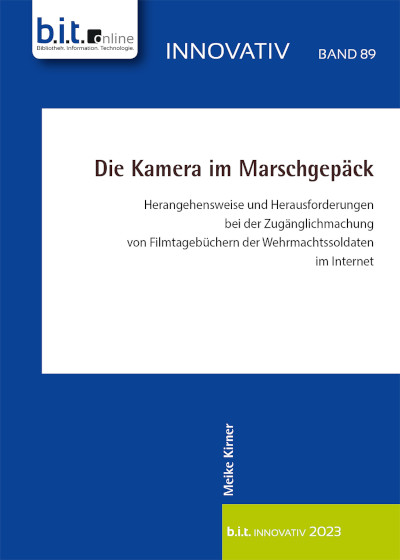



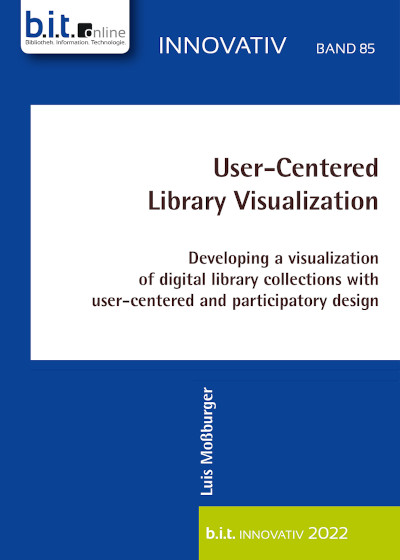

































INNOVATIV
Band 79: Janet Wagner Band 78: Philip Franklin Orr Band 77: Carina Dony Band 76:
Linda Freyberg
Sabine Wolf (Hrsg.)
Band 75: Denise Rudolph Band 74: Sophia Paplowski Band 73: Carmen Krause Band 72:
Katrin Toetzke
Dirk Wissen
Band 71: Rahel Zoller Band 70: Sabrina Lorenz Band 69: Jennifer Hale Band 68:
Linda Schünhoff
Benjamin Flämig
Band 67:
Wilfried Sühl-Strohmenger
Jan-Pieter Barbian
Band 66: Tina Schurig Band 65: Christine Niehoff Band 64: Eva May Band 63: Eva Bunge Band 62: Nathalie Hild Band 61: Martina Haller Band 60: Leonie Flachsmann Band 59: Susanne Göttker Band 58: Georg Ruppelt Band 57: Karin Holste-Flinspach Band 56: Rafael Ball Band 55: Bettina Schröder Band 54: Florian Hagen Band 53: Anthea Zöller Band 52: Ursula Georgy Band 51: Ursula Jaksch Band 50: Hermann Rösch (Hrsg) Band 49: Lisa Maria Geisler Band 48: Raphaela Schneider Band 47: Eike Kleiner
Bestellen Sie jetzt online!
17. April 2026
  WEITERE NEWS
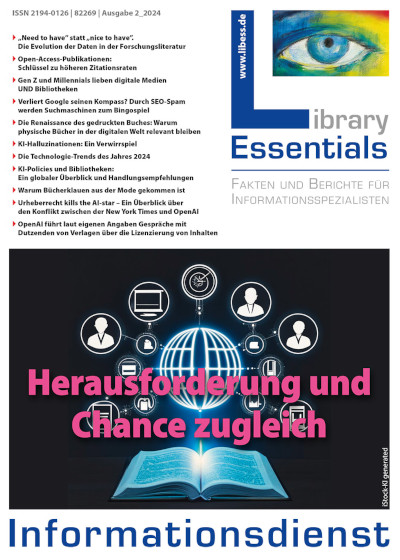
Aktuelles aus
L
ibrary
Essentials

In der Ausgabe 03/2026 (April 2026) lesen Sie u.a.:

  • Nationales Kultur­erbe unter Druck: Der Stopp des DNB-Erweiterungsbaus und seine Folgen
  • Entwicklungen im Medienalltag
  • Vom Datenhype zur Datenkompetenz: Warum Data Literacy zur Kernaufgabe
    von Bibliotheken wird
  • Warum Bibliotheken bei KI, Lizenzen
    und Fair Use mitreden müssen
  • Entwicklungen für die Zukunft
    von Bibliotheken
  • Forschungsdaten als Publikationsform
  • Wie Forschende mit KI-gestützten Recherchetools arbeiten
  • KI-Erschöpfung und „Vocational Awe“
    in wissenschaftlichen Bibliotheken
  • Aufmerksamkeitskrise oder Designproblem? Was Bibliotheken aus der Debatte über Lesen und Bildschirme lernen können
  • Die Stiftsbibliothek St. Gallen:
    Ein 1.300 Jahre altes Wissensarchiv
  • Bibliotheken als Räume für Wohlbefinden
    im Gesundheitswesen
  • Das Ende eines Formats: Der Niedergang des Massenmarkt-Paperbacks
u.v.m.
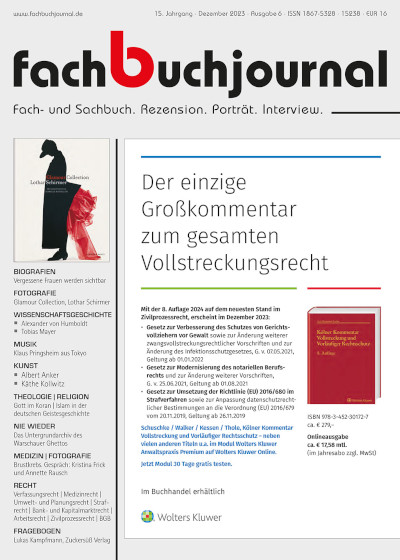
  fachbuchjournal
2009 bis 2023

ProQuest Empowers Researchers of 20th Century America with New Digital Collections

History Vault opens access to new viewpoints of landmark eras

ProQuest aims to improve outcomes of research on 20th century events and the people who made them happen by expanding its visionary ProQuest® History Vault collection of digitised primary sources. Three new modules provide online access to hard-to-find original documents chronicling the Black Freedom Struggle in the 20th Century (Federal Government Records supplement); the New Deal and World War II (President Franklin D. Roosevelt’s Office Files and Records of Federal Agencies); and critical intelligence efforts during wartime from the Office of Strategic Services (OSS-State Department Intelligence and Research Reports, 1941-1961). History Vault is part of ProQuest’s expansive digitisation program that enables students and scholars to explore history as it happened and from diverse, often personal vantage points.

The distinct viewpoints of the new modules include:  

  • Civil rights records from the Ford and Reagan presidencies, revealing the path of civil rights after 1975 on such topics as affirmative action; Bob Jones University v. U.S.; busing and school desegregation; voting rights legislation; fair housing; Martin Luther King Jr. Day; and the Civil Rights Restoration Act of 1988.

  • The administrative record of the Roosevelt White House. FDR's policies, responses to crises, and plans for the future were based on information that he received and digested from all levels of government and the public. The office files represent the materials deemed especially important by the President.

  • 3,500 World War II and Cold War era classified reports about Asia, Europe, the Soviet Union, Latin America, and Africa commissioned by the Office of Strategic Services (OSS) and the U.S. State Department and written by the days’ leading scholars. At the time, the reports helped to shape U.S. foreign policy decisions and provide an excellent source for studying the major areas of the World during the period from 1941 to 1961.

The new modules debut History Vault’s refreshed user interface, designed to improve user productivity and success. The interface has simplified paths to discovery and saves researchers’ time by making it especially easy for users to navigate the wealth of documents, finding related content and drilling deeper into their research interests.

ProQuest is committed to enabling researchers to access to high quality and authoritative content from diverse sources – catalysts for improved productivity and task success. Libraries can build rich collections by complementing History Vault’s new modules with ProQuest’s Historical Newspapers Collection, declassified government documents in Digital National Security Archive and in its other Government Collections – U.S. Congressional materials, Executive Branch Documents, British Parliamentary Papers, the upcoming House of Lords papers, Documents on British Policy Overseas. ProQuest also offers a rich selection of ebooks and other secondary sources that range from consumer and trade journals and magazines to scholarly articles and dissertations and theses.

“Librarians and scholars are looking for ways to spark serendipitous discovery and to find unique perspectives for better research outcomes,” said Susan Bokern, ProQuest vice-president, Information Solutions. “The diverse mix of content in History Vault along with other historical information ProQuest is digitising is designed to address those needs by creating online environments that ignite inspiration and make the library an exciting research and learning space.”

http://proquest.libguides.com/historyvault