






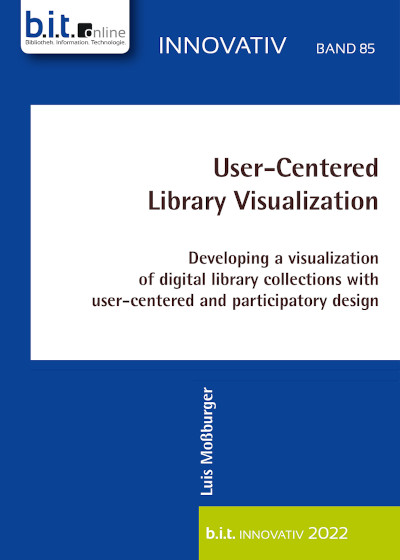







































INNOVATIV
Band 79: Janet Wagner Band 78: Philip Franklin Orr Band 77: Carina Dony Band 76:
Linda Freyberg
Sabine Wolf (Hrsg.)
Band 75: Denise Rudolph Band 74: Sophia Paplowski Band 73: Carmen Krause Band 72:
Katrin Toetzke
Dirk Wissen
Band 71: Rahel Zoller Band 70: Sabrina Lorenz Band 69: Jennifer Hale Band 68:
Linda Schünhoff
Benjamin Flämig
Band 67:
Wilfried Sühl-Strohmenger
Jan-Pieter Barbian
Band 66: Tina Schurig Band 65: Christine Niehoff Band 64: Eva May Band 63: Eva Bunge Band 62: Nathalie Hild Band 61: Martina Haller Band 60: Leonie Flachsmann Band 59: Susanne Göttker Band 58: Georg Ruppelt Band 57: Karin Holste-Flinspach Band 56: Rafael Ball Band 55: Bettina Schröder Band 54: Florian Hagen Band 53: Anthea Zöller Band 52: Ursula Georgy Band 51: Ursula Jaksch Band 50: Hermann Rösch (Hrsg) Band 49: Lisa Maria Geisler Band 48: Raphaela Schneider Band 47: Eike Kleiner
Bestellen Sie jetzt online!
6. Mai 2026
  WEITERE NEWS
Aktuelles aus
L
ibrary
Essentials

In der Ausgabe 03/2026 (April 2026) lesen Sie u.a.:

  • Nationales Kultur­erbe unter Druck: Der Stopp des DNB-Erweiterungsbaus und seine Folgen
  • Entwicklungen im Medienalltag
  • Vom Datenhype zur Datenkompetenz: Warum Data Literacy zur Kernaufgabe
    von Bibliotheken wird
  • Warum Bibliotheken bei KI, Lizenzen
    und Fair Use mitreden müssen
  • Entwicklungen für die Zukunft
    von Bibliotheken
  • Forschungsdaten als Publikationsform
  • Wie Forschende mit KI-gestützten Recherchetools arbeiten
  • KI-Erschöpfung und „Vocational Awe“
    in wissenschaftlichen Bibliotheken
  • Aufmerksamkeitskrise oder Designproblem? Was Bibliotheken aus der Debatte über Lesen und Bildschirme lernen können
  • Die Stiftsbibliothek St. Gallen:
    Ein 1.300 Jahre altes Wissensarchiv
  • Bibliotheken als Räume für Wohlbefinden
    im Gesundheitswesen
  • Das Ende eines Formats: Der Niedergang des Massenmarkt-Paperbacks
u.v.m.
  fachbuchjournal
2009 bis 2023

Nine European Institutions Join the
Ex Libris Alma Early Adopter Programme

Academic institutions across Europe select Alma
and take the lead in establishing next-generation library management services

Ex Libris® Group is pleased to announce the recent addition of nine European institutions to the early adopter programme for the Ex Libris Alma library management service.  

Over 60 institutions across three continents have so far committed to adopting Alma through various collaborative and early adopter programmes. In addition, four institutions are working with Ex Libris as development partners—Boston College; Princeton University Library; Purdue University Libraries; and Katholieke Universiteit Leuven (K.U.Leuven), which includes the LIBIS library network.  

Among the early adopters in Europe are the University of York, Lancaster University, the University of East London, the Free University of Bozen/Bolzano, and Plymouth University. Other leading institutions that are joining the programme have chosen to retain confidentiality at this time in view of their migration to Alma from other vendors.  

Gurdish Sandhu, associate director Library & Learning Services at the University of East London, commented: “Alma’s complete integration with our Primo® discovery and delivery solution ensures that we will provide a seamless experience for our users and library staff. Alma will also deliver significant cost efficiencies thanks to its cloud-based, unified workflows. Implementing Alma will enable us to conclude the journey toward a unified management and discovery system, a journey that we embarked upon three years ago with our selection of Primo.”  

“Upgrading to Alma is timely and appropriate for Lancaster University Library,” remarked Clare Powne, university librarian at Lancaster University. “A unified cloud-based system designed for multiple collections of electronic, digital, and print resources and encompassing the full spectrum of workflows for purchase, organization, and the delivery of content will significantly boost efficiency and productivity for contemporary research libraries.  

“We are impressed by the conceptual thinking underpinning Alma. The early adoption of Alma gives us an opportunity to join a global network of libraries at the forefront of novel approaches to the automated management of library operations, and meshes with our strategic aims of quality, innovation, responsiveness, and efficiency,” added Ms. Powne.  

“We are very proud to welcome this significant number of prestigious European institutions to the Alma early adopter programme,” commented Marc Daubach, corporate vice president and general manager of Ex Libris Europe. “This powerful endorsement of Alma ahead of its launch in 2012 reflects the strength with which our strategy resonates among academic and research libraries in Europe and around the world.”  

www.exlibrisgroup.com