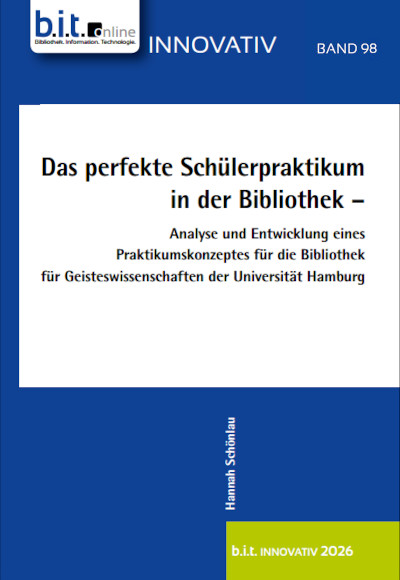

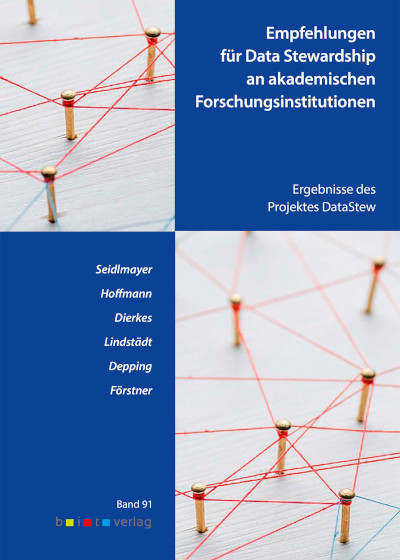




INNOVATIV
Band 79: Janet Wagner Band 78: Philip Franklin Orr Band 77: Carina Dony Band 76:
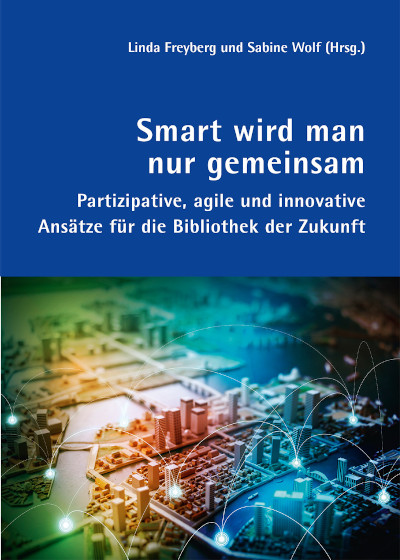
Linda Freyberg
Sabine Wolf (Hrsg.)
Band 75: Denise Rudolph Band 74: Sophia Paplowski Band 73: Carmen Krause Band 72:
Katrin Toetzke
Dirk Wissen
Band 71: Rahel Zoller Band 70: Sabrina Lorenz Band 69: Jennifer Hale Band 68:
Linda Schünhoff
Benjamin Flämig
Band 67:
Wilfried Sühl-Strohmenger
Jan-Pieter Barbian
Band 66: Tina Schurig Band 65: Christine Niehoff Band 64: Eva May Band 63: Eva Bunge Band 62: Nathalie Hild Band 61: Martina Haller Band 60: Leonie Flachsmann Band 59: Susanne Göttker Band 58: Georg Ruppelt Band 57: Karin Holste-Flinspach Band 56: Rafael Ball Band 55: Bettina Schröder Band 54: Florian Hagen Band 53: Anthea Zöller Band 52: Ursula Georgy Band 51: Ursula Jaksch Band 50: Hermann Rösch (Hrsg) Band 49: Lisa Maria Geisler Band 48: Raphaela Schneider Band 47: Eike Kleiner
Bestellen Sie jetzt online!
14. Oktober 2026
  WEITERE NEWS
Aktuelles aus
L
ibrary
Essentials

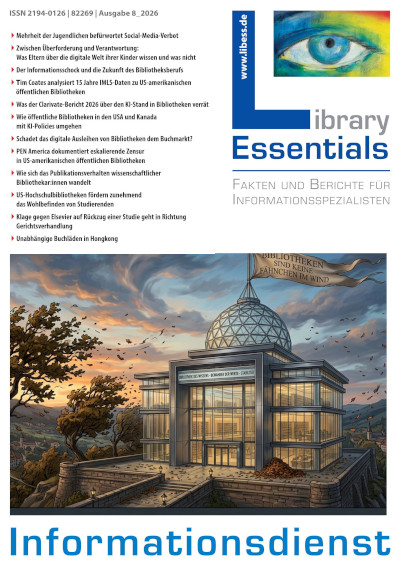
In der Ausgabe 08/2026 (Oktober 2026) lesen Sie u.a.:

  • Mehrheit der Jugendlichen befürwortet Social-Media-Verbot
  • Zwischen Überforderung und Verantwortung:
    Was Eltern über die digitale Welt ihrer Kinder wissen und was nicht
  • Der Informationsschock und
    die Zukunft des Bibliotheksberufs
  • Tim Coates analysiert 15 Jahre
    IMLS-Daten zu US-amerikanischen öffentlichen Bibliotheken
  • Was der Clarivate-Bericht 2026 über
    den KI-Stand in Bibliotheken verrät
  • Wie öffentliche Bibliotheken in den USA
    und Kanada mit KI-Policies umgehen
  • Schadet das digitale Ausleihen von Bibliotheken dem Buchmarkt?
  • PEN America dokumentiert eskalierende Zensur in US-amerikanischen
    öffentlichen Bibliotheken
  • Wie sich das Publikationsverhalten wissenschaftlicher Bibliothekar:innen wandelt
  • US-Hochschulbibliotheken fördern zunehmend das Wohlbefinden
    von Studierenden
  • Klage gegen Elsevier auf Rückzug einer Studie geht in Richtung Gerichtsverhandlung
  • Unabhängige Buchläden in Hongkong
u.v.m.
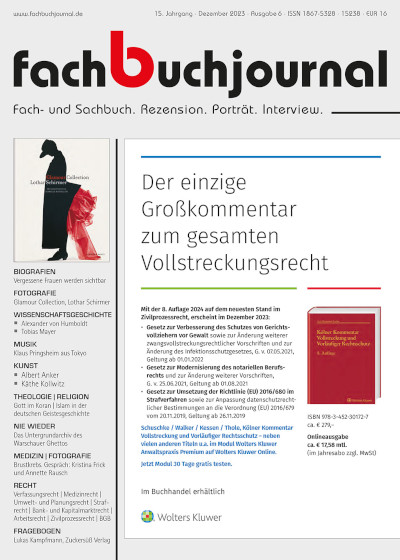
  fachbuchjournal
2009 bis 2023

Springer Nature and leading African academies
launch first pan-African research integrity survey

Springer Nature, the African Academy of Sciences (AAS) and the Academy of Science South Africa (ASSAf) have launched the first continent-wide survey examining researchers’ experiences of research integrity training and support.

The initiative aims to ensure African researchers’ perspectives inform global under­standing of how research integrity is taught, supported and embedded across research systems. The partnership combines Springer Nature’s experience in engaging research communities on research integrity with the leadership, regional expertise and networks of AAS and ASSAf.

The survey will examine what integrity training researchers receive, how it is delivered, which topics are covered, and whether current support reflects their roles, responsibi­lities and needs. Research integrity underpins reliable research, enabling findings to be built upon and used to inform policy and practice. Yet evidence remains limited on how integrity training and support are experienced across different research systems and regions. Evidence from across Africa will help build a more complete picture of researchers’ needs.

Commenting on the launch, Susan Veldsman, Scholarly Publishing Programme manager at the Academy of Science of South Africa said:

“Research integrity is fundamental to maintaining confidence in science and evidence-informed decision making. We welcome the opportunity to partner with Springer Nature and the African Academy of Sciences on this important survey, which gives South African researchers an opportunity to share their experiences directly.

Researchers across Africa bring unique perspectives that are essential to under­standing how research integrity is supported globally. By reflecting researchers’ voices in the evidence base, the survey will help identify what support is working well, where gaps remain and what is needed at different stages of a research career. That evidence will be valuable for South Africa and can help inform training and guidance that reflects researchers' real experiences, while contributing to a stronger culture of integrity across the research ecosystem.”

Vuyo Mliswa, Academic Affairs Manager at Springer Nature, added:

“Research across Africa makes a significant contribution to global science, yet researchers’ experiences of research integrity training and support remain underrepresented in the evidence base. We’re delighted to be partnering with the African Academy of Sciences and the Academy of Science South Africa, whose leadership and networks are critical to ensuring that African researchers are represented in this work.”

The initiative extends Springer Nature’s wider programme of comparative surveys on research integrity training, conducted in partnership with scientific organisations around the world. Previous surveys have been conducted in Australia, Brazil, China, India, Japan, the US and the UK, contributing to a comparative picture of researcher views on integrity education.

Findings from a recent white paper analysing the previous seven surveys revealed widespread disparities in the provision of integrity training. Despite this variation, support for research integrity education was consistently high, with 84% to 94% of researchers supporting mandatory training at some point in their careers.

The surveys also revealed clear patterns in the topics where researchers wanted further support. Authorship guidance was the only non-data-related topic to appear in the top ten training needs across all seven countries surveyed. In Australia, the US, the UK and Brazil, topics relating to the management and sharing of research data were particularly prominent, accounting for most of the top ten areas where respondents wanted more training.

This latest survey complements Springer Nature’s engagement with researchers through the African Research Advisory Council, which provides a forum for discussing the priorities and challenges facing the African research community.

These discussions have highlighted the importance of strengthening African research capacity, leadership and independence. By collating data on the provision of integrity training across the continent, the survey aims to contribute to that wider discussion and help inform future research integrity training and policy development.

springernature.com