













































INNOVATIV
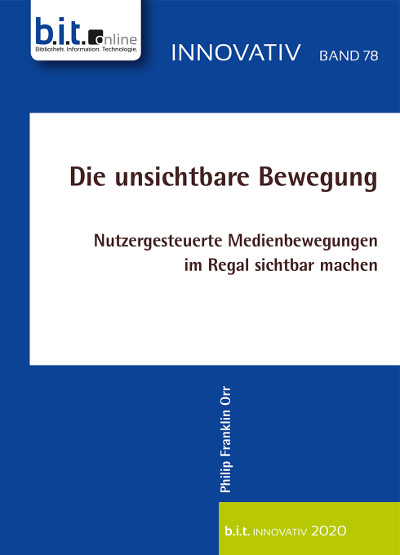
Band 79: Janet Wagner Band 78: Philip Franklin Orr Band 77: Carina Dony Band 76:
Linda Freyberg
Sabine Wolf (Hrsg.)
Band 75: Denise Rudolph Band 74: Sophia Paplowski Band 73: Carmen Krause Band 72:
Katrin Toetzke
Dirk Wissen
Band 71: Rahel Zoller Band 70: Sabrina Lorenz Band 69: Jennifer Hale Band 68:
Linda Schünhoff
Benjamin Flämig
Band 67:
Wilfried Sühl-Strohmenger
Jan-Pieter Barbian
Band 66: Tina Schurig Band 65: Christine Niehoff Band 64: Eva May Band 63: Eva Bunge Band 62: Nathalie Hild Band 61: Martina Haller Band 60: Leonie Flachsmann Band 59: Susanne Göttker Band 58: Georg Ruppelt Band 57: Karin Holste-Flinspach Band 56: Rafael Ball Band 55: Bettina Schröder Band 54: Florian Hagen Band 53: Anthea Zöller Band 52: Ursula Georgy Band 51: Ursula Jaksch Band 50: Hermann Rösch (Hrsg) Band 49: Lisa Maria Geisler Band 48: Raphaela Schneider Band 47: Eike Kleiner
Bestellen Sie jetzt online!
28. Februar 2026
  WEITERE NEWS
Aktuelles aus
L
ibrary
Essentials

In der Ausgabe 10/202501/2026 (Dezember – Januar 2025–2026) lesen Sie u.a.:

  • Soziale Medien und Aufmerksamkeits­entwicklung bei Kindern: Neue Lang­zeitdaten zur ADHS-Risikodiskussion
  • Repositorien im Wandel: Analyse zentraler Einflussfaktoren für die nächsten Jahre
  • Wie inklusiv Sammlungen in Bibliotheken und Archiven wirklich sind
  • Synergien von KI-Chat und Suche:
    Wie unterschiedliche Altersgruppen
    Information Retrieval neu gestalten
  • Kulturerbe-Daten im Zeitalter der KI:
    Ein neues Zugangsmodell für Institutionen
  • Jugendliche, soziale Medien und KI-Chatbots: Digitale Nutzungsrealitäten 2025
  • Buchclubs als unterschätzte Brücke zwischen Campusleben und Bibliothek: Neue Impulse aus US-Hochschulbibliotheken
  • AI Librarian in Japan
  • Altersgrenzen für soziale Medien:
    Europas nächste Regulierungsdebatte
  • KI und Journalismus:
    Neue Machtverschiebungen
    im Markt für Nachrichteninhalte
  • Print ist tot, es lebe Print!
u.v.m.
  fachbuchjournal

Springer Nature proposes five essential factors to accelerate data sharing

A white paper released today draws on surveys of over 11,000 researchers to make concrete recommendations that ensure good data practice

Data Sharing, published by Springer Nature today, translates findings about researcher attitudes and behaviours into concrete measures that will accelerate data sharing. The white paper builds on a number of reports published in 2018 that pinpoint challenges researchers face when sharing data. The barriers identified include, for example, how to organize data in a presentable and useful way, confusion about copyright, and not knowing where data can be shared. Five Essential Factors for Data Sharing outlines approaches needed to tackle these and further barriers. The white paper and its underlying data are freely available via the figshare repository.     

Data sharing and good data management has been found to make research studies more productive, more likely to be cited and unlock innovation for the good of society. Data archiving, for example, can double the publication output of research projects, and has been associated with an increase in the citation impact of research papers by as much as 50 per cent. According to a new report for the European Commission, the minimum cost to the EU of poor data practice is €10.2 billion per year.  

“While we continue to see researchers increasingly sharing data, the majority of the research community are not yet managing or sharing data in ways that make it findable, accessible or reusable. The utopia of findable, accessible, interoperable and reusable (FAIR) data is still some way off,” explained Grace Baynes, Vice President Research Data & New Product Development at Springer Nature.

The white paper summarises the five essential factors to accelerate data sharing as:  

  • Clear policy: from funders, institutions, journals, publishers, and research communities. Setting unambiguous and specific requirements for data management and sharing to lead to a shift in researcher behaviour.

  • Better credit: to make data sharing worth a researcher’s time. With more formal recognition through data citations, authorship, inclusion in research assessments, and career advancement, data sharing will increase. 

  • Explicit funding: for data management and data sharing, as well as data publishing. Policy without access to dedicated funding to enable compliance is unlikely to result in increased data sharing.

  • Practical help: for organizing data, finding appropriate repositories and provision of faster, easier routes to share data. The majority of researchers don’t know how or where to make their research data available.

  • Training and education: to answer common questions from researchers on data sharing and help build skills and knowledge. Communicating the benefits of best data practice and addressing common areas of concern. 

Iain Hrynaszkiewicz, Head of Data Publishing at Springer Nature, said: “None of these essential factors can be solved by one stakeholder alone: we must act together, and we must act now, to encourage data sharing across discipline and geographic boundaries. Support from all stakeholders – funders, institutions, publishers, and the wider research community – could make all the difference.”

springernature.com/group