










































INNOVATIV
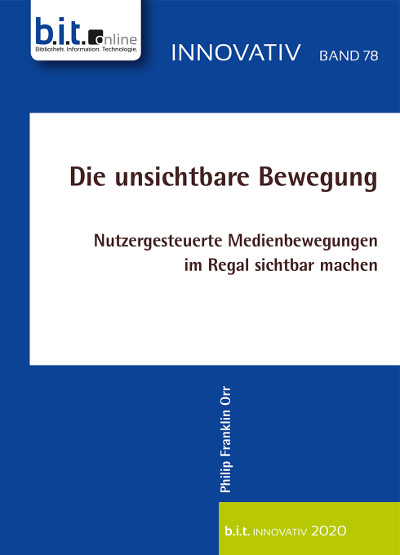
Band 79: Janet Wagner Band 78: Philip Franklin Orr Band 77: Carina Dony Band 76:
Linda Freyberg
Sabine Wolf (Hrsg.)
Band 75: Denise Rudolph Band 74: Sophia Paplowski Band 73: Carmen Krause Band 72:
Katrin Toetzke
Dirk Wissen
Band 71: Rahel Zoller Band 70: Sabrina Lorenz Band 69: Jennifer Hale Band 68:
Linda Schünhoff
Benjamin Flämig
Band 67:
Wilfried Sühl-Strohmenger
Jan-Pieter Barbian
Band 66: Tina Schurig Band 65: Christine Niehoff Band 64: Eva May Band 63: Eva Bunge Band 62: Nathalie Hild Band 61: Martina Haller Band 60: Leonie Flachsmann Band 59: Susanne Göttker Band 58: Georg Ruppelt Band 57: Karin Holste-Flinspach Band 56: Rafael Ball Band 55: Bettina Schröder Band 54: Florian Hagen Band 53: Anthea Zöller Band 52: Ursula Georgy Band 51: Ursula Jaksch Band 50: Hermann Rösch (Hrsg) Band 49: Lisa Maria Geisler Band 48: Raphaela Schneider Band 47: Eike Kleiner
Bestellen Sie jetzt online!
16. Oktober 2026
  WEITERE NEWS
Aktuelles aus
L
ibrary
Essentials

In der Ausgabe 08/2026 (Oktober 2026) lesen Sie u.a.:

  • Mehrheit der Jugendlichen befürwortet Social-Media-Verbot
  • Zwischen Überforderung und Verantwortung:
    Was Eltern über die digitale Welt ihrer Kinder wissen und was nicht
  • Der Informationsschock und
    die Zukunft des Bibliotheksberufs
  • Tim Coates analysiert 15 Jahre
    IMLS-Daten zu US-amerikanischen öffentlichen Bibliotheken
  • Was der Clarivate-Bericht 2026 über
    den KI-Stand in Bibliotheken verrät
  • Wie öffentliche Bibliotheken in den USA
    und Kanada mit KI-Policies umgehen
  • Schadet das digitale Ausleihen von Bibliotheken dem Buchmarkt?
  • PEN America dokumentiert eskalierende Zensur in US-amerikanischen
    öffentlichen Bibliotheken
  • Wie sich das Publikationsverhalten wissenschaftlicher Bibliothekar:innen wandelt
  • US-Hochschulbibliotheken fördern zunehmend das Wohlbefinden
    von Studierenden
  • Klage gegen Elsevier auf Rückzug einer Studie geht in Richtung Gerichtsverhandlung
  • Unabhängige Buchläden in Hongkong
u.v.m.
  fachbuchjournal
2009 bis 2023

ProQuest SIPX Recognized as a Way to Reduce Adoption Barriers to OER Content

Innovative technology helps universities reduce costs for students and enhance learning success

ProQuest SIPX is paving the way for higher education institutions and campus leaders to reduce students’ cost of education by leveraging increased use of open educational resources (OER) as part of the SIPX® complete course materials solution.

ProQuest SIPX has generated more than $3.6million to date in savings for students and schools across the US. A recent article from information industry analyst Outsell notes that SIPX helps to solve the problem of lower student outcomes because of prohibitively expensive curriculum resources. SIPX serves a growing need and role as Outsell points out “the increasing willingness of institutions to invest time and energy in compiling OER repositories, and to share courses they have created which use OER materials.”

Access to OER is ever more critical for institutions and SIPX not only makes it easy for instructors to understand the costs of their selected course readings, but also surfaces OER and library-subscribed resources that are free for students deeper into instructor workflows and platforms such as their native campus Learning Management Systems and bookstore coursepacks, making it easier to connect and adopt these resources.

“The viral effect is likely to kick in as this process continues, since it reduces the barriers to using OERs,” says Outsell. “If it no longer takes more time to find OERs than it does to select a textbook, and if offering free resources has proven benefits to course completion rates, then the OER argument looks increasingly persuasive”.

“A primary goal of SIPX when we built this solution was to combat the rising costs of education by making it easier for schools and teachers to create effective learning experiences with the high quality content they want to use, and reduce costs for students,” said Franny Lee (Co-Founder and General Manager of ProQuest SIPX). “We feel that bridging easier access to relevant, quality Open Educational Resources is a key factor in helping solve these cost problems being faced by higher education institutions and students.”

www.sipx.com
http://www.proquest.com