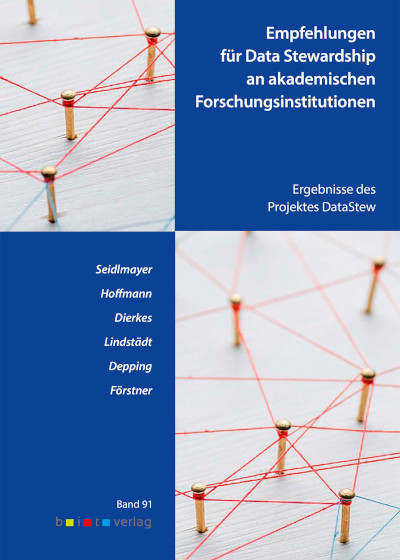
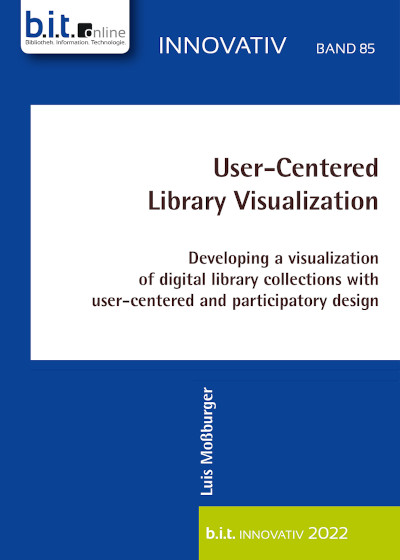
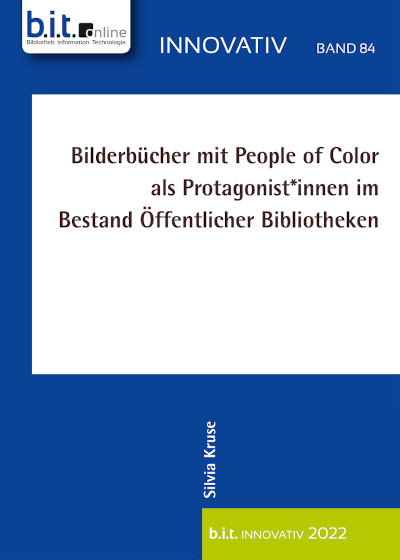
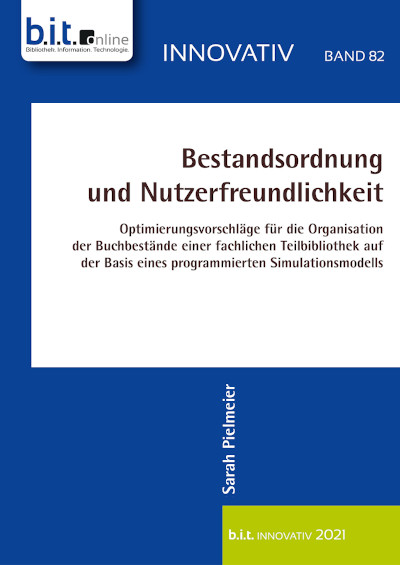

INNOVATIV
Band 79: Janet Wagner Band 78: Philip Franklin Orr Band 77: Carina Dony Band 76:
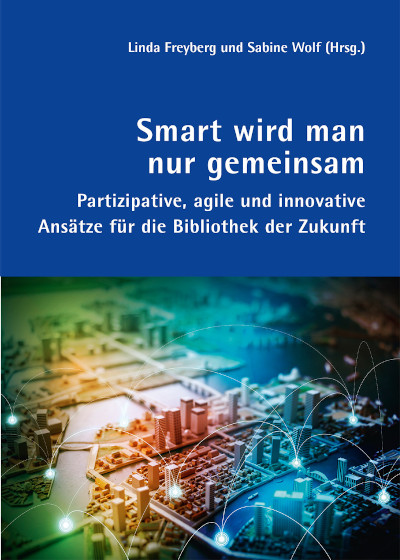
Linda Freyberg
Sabine Wolf (Hrsg.)
Band 75: Denise Rudolph Band 74: Sophia Paplowski Band 73: Carmen Krause Band 72:
Katrin Toetzke
Dirk Wissen
Band 71: Rahel Zoller Band 70: Sabrina Lorenz Band 69: Jennifer Hale Band 68:
Linda Schünhoff
Benjamin Flämig
Band 67:
Wilfried Sühl-Strohmenger
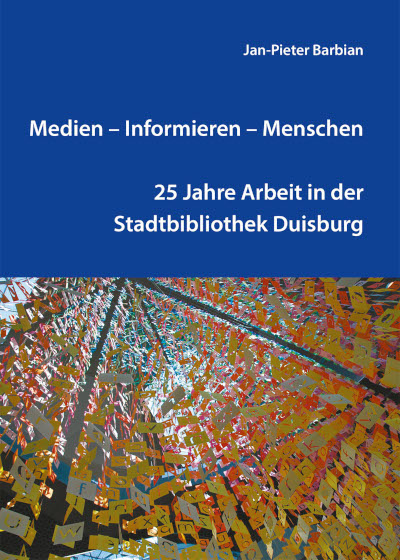
Jan-Pieter Barbian
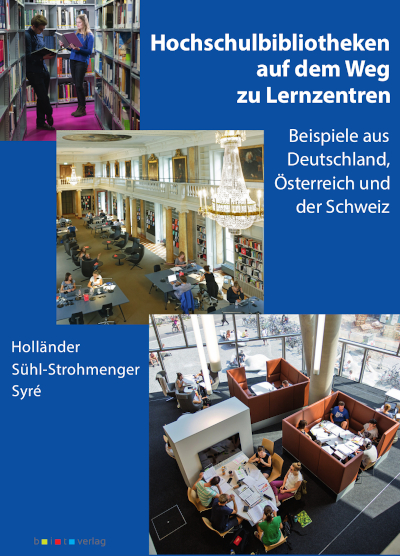
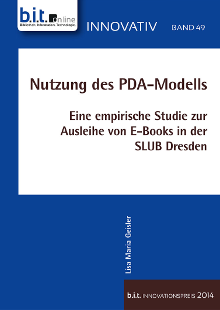
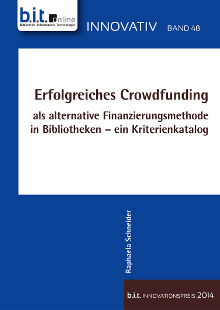
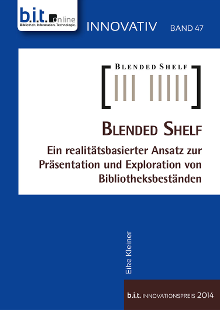
Band 66: Tina Schurig Band 65: Christine Niehoff Band 64: Eva May Band 63: Eva Bunge Band 62: Nathalie Hild Band 61: Martina Haller Band 60: Leonie Flachsmann Band 59: Susanne Göttker Band 58: Georg Ruppelt Band 57: Karin Holste-Flinspach Band 56: Rafael Ball Band 55: Bettina Schröder Band 54: Florian Hagen Band 53: Anthea Zöller Band 52: Ursula Georgy Band 51: Ursula Jaksch Band 50: Hermann Rösch (Hrsg) Band 49: Lisa Maria Geisler Band 48: Raphaela Schneider Band 47: Eike Kleiner
Bestellen Sie jetzt online!
14. Januar 2026
  WEITERE NEWS
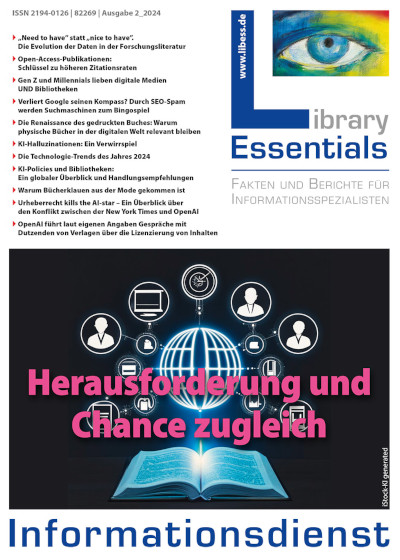
Aktuelles aus
L
ibrary
Essentials

In der Ausgabe 9/2025 (Dezember 2025) lesen Sie u.a.:

  • Rethinking Science in the Age of AI: Wie Künstliche Intelligenz die wissenschaftliche Praxis verändert
  • Warum Antworten und Wissen nicht das Gleiche sind: Wenn KI das Lernen verändert
  • Fachwissen zwischen Vergangenheit
    und Zukunft: Wie Archivar:innen digitale Kulturerbe-Archive neu denken
  • Cambridge-Report fordert neue Ansätze für ein nachhaltiges Open-Research-Ökosystem
  • Wie Verlage und Plattformen
    mit KI gegen Paper Mills vorgehen
  • Bibliotheken retten Leben
  • Aufmerksamkeit von Kindern
    im Zusammenhang mit Mediennutzung
  • Daten oder Untergang: Elsevier-Chef Y.S. Chi über die Zukunft des Publizierens
  • Bibliotheken öffnen ihre Archive
    für das KI-Zeitalter
  • Wenn wir Bücher entwerten,
    entwerten wir die Zukunft
u.v.m.
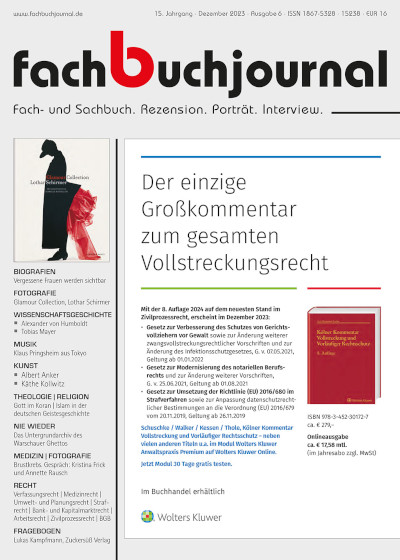
  fachbuchjournal

New Study from Thomson Reuters Examines the Resurgence
in Scientific Progress in the Middle East

Although the Middle East produces only 4% of the world’s scientific literature, its output has grown rapidly during the last ten years and there is evidence of a resurgence in scientific progress. A study released today by Thomson Reuters identifies the fields of research contributing to this resurgence and also examines the need for change in order to continue the region’s recent growth and global scientific presence.

The study, Exploring the Changing Landscape of Arabian, Persian and Turkish Research, includes a foreword from Ahmed Zewail, Nobel Laureate and professor of chemistry and physics, California Institute of Technology. Professor Zewail spells out his three essential ingredients for scientific progress in the region: expanding educational opportunities, increasing freedom through the reform of national constitutions, and establishing centers of excellence in science and technology in each nation.

Jonathan Adams, director of research evaluation at Thomson Reuters and one of the report’s authors, comments: “Investment in research in the Middle East is typically only a quarter of the world average. Increasing resources for research, fostering human capacity through improvements in education, and expanding collaboration internationally are needed to continue the region’s recent growth.”

According to the study, research output for the 14 countries analyzed in the report increased from 760,000 to more than 1,160,000 publications during the ten year period. Although the region’s scientific output is now growing at a faster rate than any other region, it is doing so from a low and concentrated base where the five largest producers – Turkey, Iran, Egypt, Saudi Arabia and Jordan – currently account for 90 percent of the regional output.

When looking at the influence of scientific literature, as measured by citation impact, the study notes that the five largest producers in the region achieved only half the world average. Influence is improving, however, and in certain fields some nations exceed the world average, making it into the top 1 percent of highly cited papers: these include Egypt and Saudi Arabia in mathematics and Turkey in engineering.

Collaboration (co-authorship) within the region and with nations beyond the Middle East is below what is typically observed elsewhere. Egypt, Jordan and Saudi Arabia collaborate across their borders on about 40 percent of their publications, while Iran and Turkey do so about half as much or less. The United States is generally the most frequent research partner followed by the United Kingdom and Germany. Egypt, the report observes, holds a pivotal role within the region and serves as a bridge with Europe, North Africa and into the United States and Japan.

The study is part of the Global Research Report series from Thomson Reuters that illustrates the changing landscape and dynamics of scientific research around the world. These studies draw on data found in Web of Science, available on the Thomson Reuters Web of Knowledge platform — the world’s largest citation environment of the highest quality scholarly literature, as represented in InCites and other evaluative offerings.

To download a copy of the report, please visit: http://researchanalytics.thomsonreuters.com/grr/